National Park Safari
Guaranteed wild elephants, almost any day
South · All year
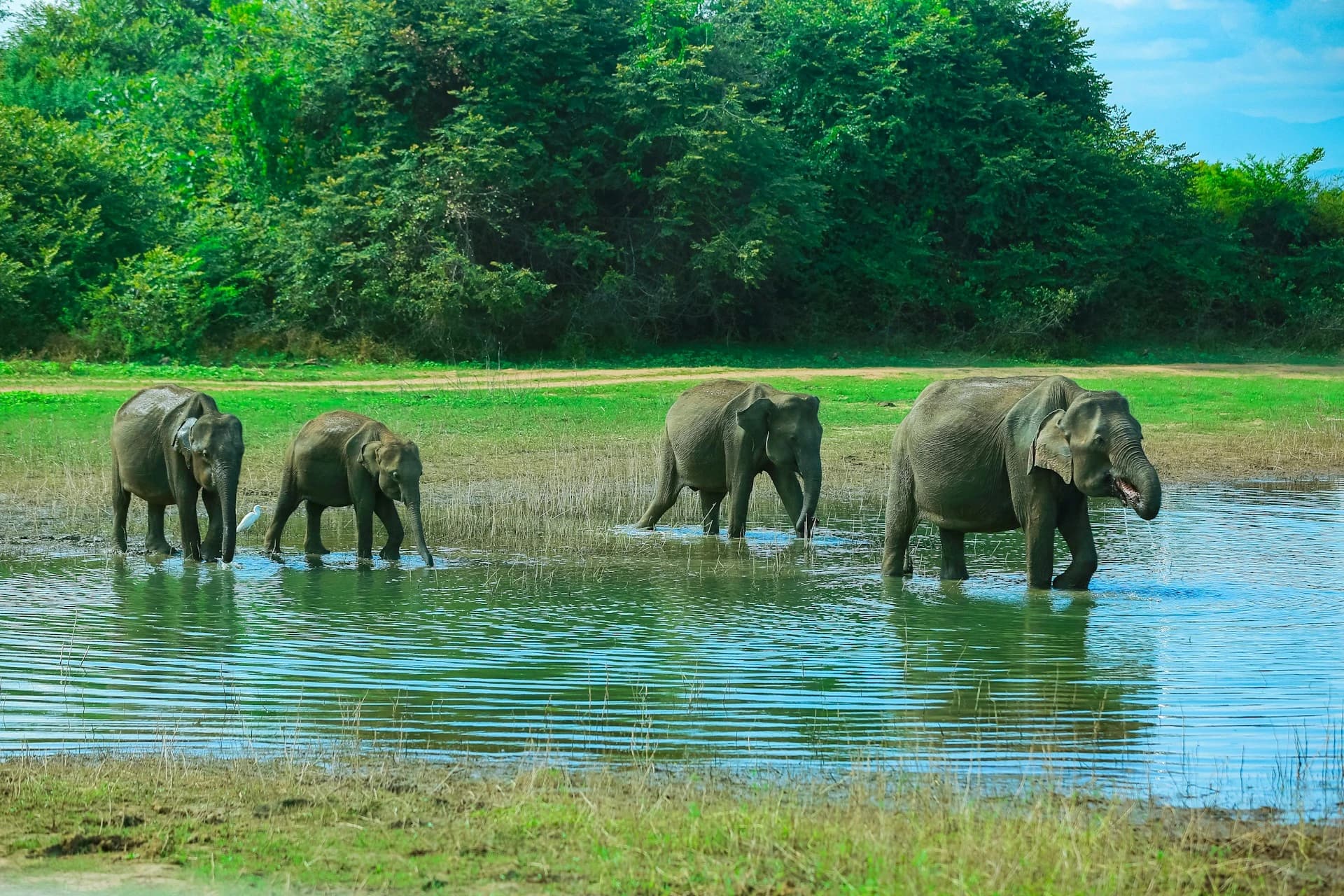
If your one worry about a safari is driving for hours and seeing nothing, Udawalawe is the answer. A few hundred elephants live here year-round on open grassland, and on most drives you'll see them within the first half hour. It's the closest thing to a sure thing in Sri Lankan wildlife.
The landscape does half the work. Much of the park is former farmland and scrub around a large reservoir, so there's little dense forest to hide behind — elephants graze in the open, often close to the track. That openness is why Udawalawe is the park we point families, first-timers and anyone short on time towards.
It's an easier day than Yala in every sense: calmer, less frantic, no jockeying for a leopard. You trade the thrill of the hunt for the near-certainty of good, unhurried elephant sightings — and for a lot of people, that's the better trip.
Around 250 elephants live in the park year-round. Herds with calves graze the open grassland most of the day, so sightings don't hinge on luck or the dry season the way leopards do.
Beside the park, the government-run Transit Home raises orphaned calves and releases them back to the wild — not a place you touch or ride elephants. You watch a public feeding from a viewing platform and pair it with your drive.
Little dense forest means animals are out in the open and simple to photograph — buffalo, deer, crocodiles at the water's edge, and a lot of birds of prey overhead.
No dawn scramble, no crowd chasing a sighting. Udawalawe is the calmest introduction to a Sri Lankan safari, which is why it works so well for children and older travellers.
You don't need to be at the gate before sunrise to have a good day at Udawalawe — the elephants are out whether you go early or late. A morning drive is still cooler and better for photos, but the pressure that comes with a leopard park simply isn't here.
Most of the drive follows tracks near the reservoir and across open plains, where visibility is long and herds are easy to spot from a distance. Your driver gives calves a respectful berth — the resident elephants are used to jeeps, but they're wild animals with young, and good drivers keep it that way.
It pairs naturally with the Elephant Transit Home. Feeding sessions run a few times a day, so timing your drive to catch one either side is the classic half-day here.
Cooler air, better light, active birdlife. A relaxed start around 6–6:30am, back by mid-morning.
A 2:30–3pm start into golden hour. Elephants are still out, and you can line it up with a late Transit Home feeding.
A game drive plus a public feeding at the Elephant Transit Home — the most popular way to spend a half day here, especially with children.
Best time
Any time of year, which is part of Udawalawe's appeal. Elephants are resident and visible in every season. The drier months from May to September concentrate wildlife around the reservoir a little more, but there's no bad month for elephants here.
Getting there
The park sits inland off the southern plains, near Udawalawe town. From the south-coast beaches it's about 2–2.5 hours; from Ella roughly 2 hours down the escarpment; from Yala or Tissamaharama around 1.5–2 hours, which is why so many people do both. From Colombo or the airport, allow about 4.5–5 hours.
How long
A single game drive runs about 3 to 3.5 hours. With the Elephant Transit Home added, plan a comfortable half day.
Tell us your dates and what you'd love to see. We'll send a friendly, no-obligation itinerary and quote within 24 hours.